
What is a Camino Passport
The Camino de Santiago, also known as the Way of St James, is a network of pilgrimage routes leading to the shrine of Saint James in Santiago de Compostela, Galicia, in northern Spain. The route attracts thousands of pilgrims each year for spiritual, cultural, and personal reasons.
A Camino Pilgrim Passport, also called a Credencial del Peregrino, is used throughout the journey. It records the pilgrimage and allows access to official pilgrim accommodation along the way.
This completed passport is required to receive the Compostela, the official certificate issued in Santiago de Compostela when the pilgrimage is completed.
What does a Pilgrim Passport looks like ?
The passport is a compact booklet, usually 4×6 inches in size and is typically made from thick paper or light cardboard and contains around 32 to 48 pages.
The cover often shows the scallop shell symbol of the Camino de Santiago. Inside are blank sections for stamps, known as sellos. Some passports include prayers or blessings from the Codex Calixtinus, a medieval text linked to early pilgrimage traditions.
Each page is used to collect stamps from towns, churches, cafés, albergues, and other places along the route. Common places for stamps include:
- Albergues (pilgrim hostels)
- Churches and cathedrals
- Bars and cafés
- Shops and bakeries
- Museums and tourist offices
Why is it called a Credential ?
The word Credencial comes from Spanish and means identification or credential.
Historically, pilgrims carried letters of safe conduct during medieval times. The modern Camino passport continues this idea. It confirms that the traveller is an official pilgrim walking the Camino de Santiago.
The document is accepted at albergues and pilgrim hostels across Spain and Portugal.
Why you collect stamps on the Camino
Stamps, a sello, act as proof of the pilgrimage journey. They show where a pilgrim has travelled and stayed along the route. To qualify for the Compostela, pilgrims must complete at least 100 km on foot or 200 km by bicycle.
Stamps are usually collected at least twice per day. This confirms consistent progress along the route. Each stamp adds a record of places visited and people met along the way.
The passport becomes both proof of completion and a personal travel diary and is is required when applying for the Compostela certificate in Santiago de Compostela.
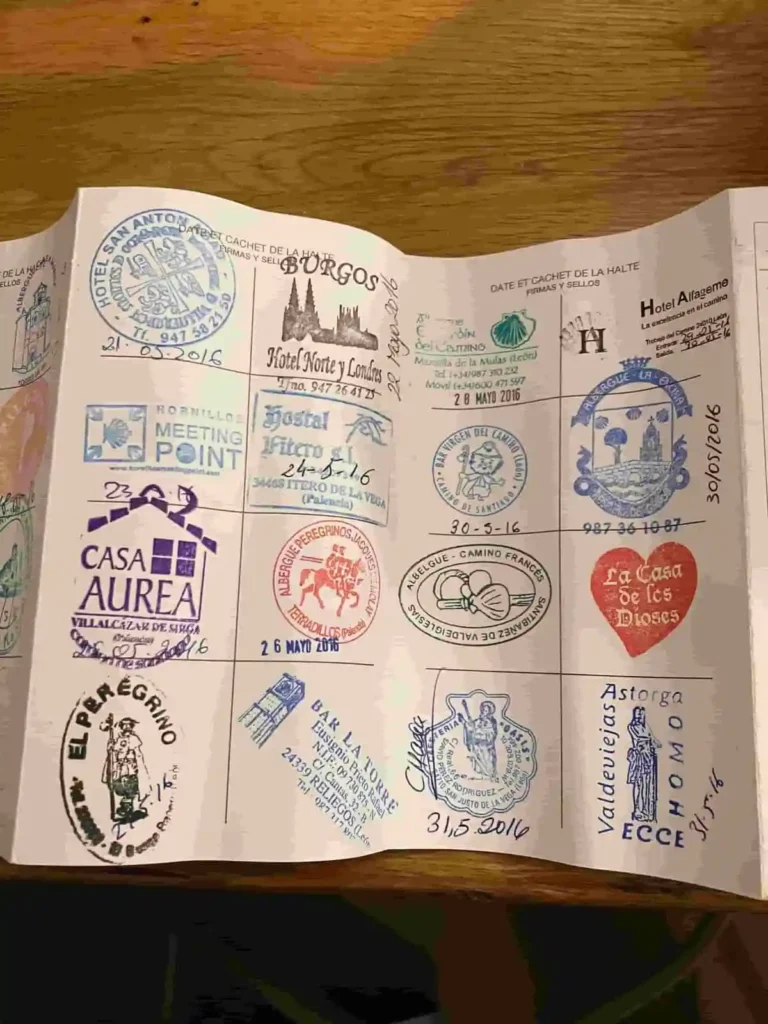
What does a completed Passport look like ?
A completed Camino passport is filled with stamps from different towns, churches, and hostels. Each stamp is unique. Some are simple ink marks. Others include detailed designs from local institutions.
Together, they create a visual record of the entire journey across the Camino de Santiago. Many pilgrims keep their passport as a personal souvenir after finishing the route. This is what one of mine looks like.
Where do I get a Pilgrim Passport
A Camino passport can be obtained before or during the pilgrimage. Common starting points include pilgrim offices, churches, and associations connected to the Camino de Santiago.
On the Camino Francés, the Pilgrim Office in Saint-Jean-Pied-de-Port issues passports at the beginning of the route.
On the Camino Portuguese, passports are available at Porto Cathedral. Tourist offices in Porto do not issue them.
Other places to collect a passport include:
- Churches along Camino routes
- Pilgrim associations
- Selected hostels and accommodation providers
International Camino organisations also distribute passports, including:
- American Pilgrims on the Camino
- Confraternity of St James in the UK
- Australian Friends of the Camino
- Camino Society of Ireland
- The Canadian Company of Pilgrims
- Confraternity of St James in South Africa
It’s always a good idea to get your Camino passport before you start your Camino and if you don’t have an association to get one from you can always get one from Ivar at the Camino de Santiago forum. They cost around $3 each.
Different versions exist for walkers, cyclists, and specific routes and pilgrims should choose the correct passport for their journey.
Importance of the Camino Passport
The Camino passport is more than a travel document, it is proof of participation in the Camino de Santiago pilgrimage. The passport allows access to affordable pilgrim accommodation known as albergues and records the physical journey and supports the spiritual experience of the Camino.
The passport also reflects values linked to the Camino, including simplicity, community, and reflection.
Conclusion
The Camino Pilgrim Passport is more than just a travel document; it is a symbol of one’s spiritual and personal quest along the Camino de Santiago. From its humble appearance to the significance of collecting stamps, the passport holds immense value for pilgrims on this transformative journey.
So, if you’re planning to embark on the Camino, remember to obtain your Camino Pilgrim Passport and let it be your companion throughout this remarkable pilgrimage of self-discovery and growth.
Buen Camino!
 English
  Spanish
  German
  French
  Dutch
Dutch
Comments